Frozen pipe season: a plumbing shop's playbook for the first hard freeze
The first night in the teens floods your phones with frozen and burst pipe calls. Here is how to triage them, what to tell callers before a truck rolls, what to stock, and the customer text to send two days before the cold hits.
By Rivet Editorial Team · · 8 min read
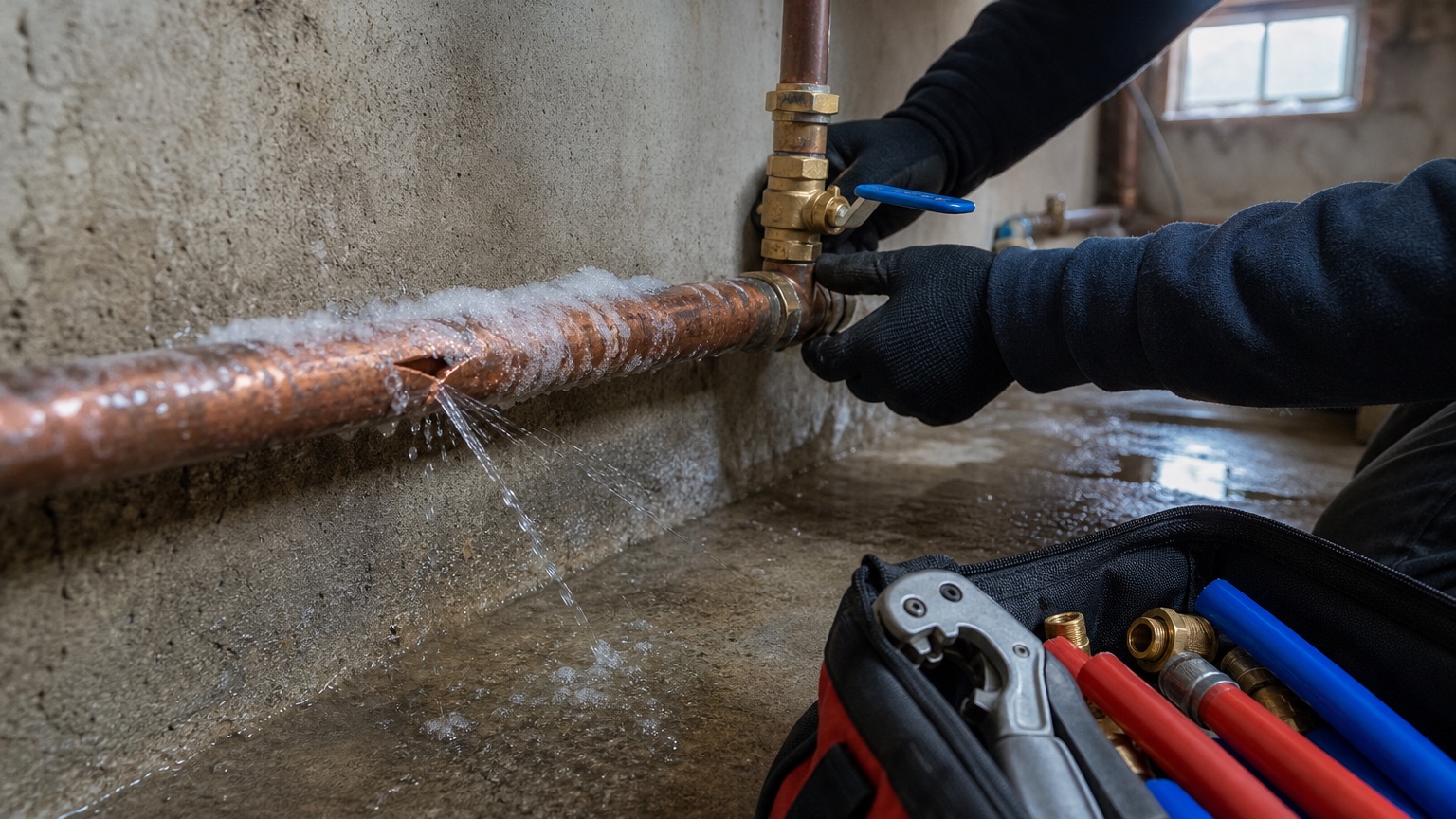
The short version: when the forecast shows the first night in the teens, a plumbing shop wins or loses the week on three things it can set up today. A triage rule that separates "water is spraying" from "no water at the kitchen sink." A 60-second phone script that tells every caller what to do before your truck arrives. And a text to your customer list two days before the cold, so the easy calls never happen.
This is the playbook, with the numbers behind it.
Why the first freeze is worth preparing for
Burst pipes are expensive for the homeowner, which is why callers are panicked and why they will book whoever answers first.
- State Farm says it handled more than 20,000 frozen pipe and winter water claims from 2024 through June 2025, paid more than $628 million, and the average claim payment exceeded $30,000. The top five states by total claim cost were Illinois, Oregon, Washington, Texas and Tennessee (State Farm release, January 2026).
- The Insurance Information Institute puts the average homeowners claim for "water damage and freezing" at $15,400 for 2019–2023, and that category made up 22.6% of homeowners losses in 2023.
Notice the list of states. Texas and Tennessee are on it. The Red Cross makes the same point: freezing is a particular problem in warmer climates, where pipes often run through uninsulated or underinsulated attics and crawl spaces. If your shop is in the South, do not assume the freeze plan is a northern problem.
State Farm flags the danger zone as pipes in attics, crawl spaces and exterior walls, "especially when temperatures drop below 20°F." Use that as your trigger.
Your trigger: the 20°F forecast
Pick a rule and write it down: when the 7-day forecast shows a low of 20°F or colder, the freeze plan starts. Not when the first burst-pipe call comes in. By then the phones are already ringing.
Step 1: Send the pre-freeze text two days out
Every frozen pipe you prevent is one less 2 a.m. call you have to juggle against a real burst. It also makes your shop the one the customer remembers when something does go wrong.
Send this to past customers 48 hours before the cold arrives. Every tip in it comes from the American Red Cross frozen pipe fact sheet.
Hi, it's [Shop] Plumbing. Temps are dropping to [low]°F on [day]. Five things that prevent frozen pipes: 1. Disconnect garden hoses. Close the inside valve to each outdoor faucet, then open the outdoor faucet so it drains. 2. On the coldest nights, let a thin trickle of cold water run at faucets on outside walls. 3. Open sink cabinet doors on outside walls (move cleaners out of kids' reach). 4. Keep the thermostat the same day and night. Leaving town? Keep the heat at 55°F or higher. 5. Keep the garage door closed if water lines run through it. If a pipe bursts, shut off your main water valve and call us at [number], 24/7.
Two notes on the text:
- Ask them to find the main shutoff now. Add one line: "Not sure where your main shutoff is? Reply and we'll help." Those replies are warm leads for shutoff valve replacements and pipe insulation work before the freeze.
- Mention the heat on vacant homes. The NAIC (the national association of state insurance regulators) notes that policies generally require homeowners to keep the home at a minimum temperature, and to shut off the water when the home is vacant. A coverage problem for your customer becomes a collections problem for you.
Step 2: Triage every call into one of three buckets
During a freeze, your dispatcher's real job is sorting calls, not booking them. Use three buckets and make every person who answers the phone use the same words.
Bucket A: Active water. Roll now.
Water spraying, ceiling dripping, water coming through a light fixture, pipe visibly split.
- Get the caller to shut off the main valve before you hang up (script below).
- This call goes to the front of the line. A burst that is still running gets more expensive every minute.
Bucket B: Frozen, not burst. Coach first, schedule second.
No water or only a trickle at one or more fixtures, no visible leak. The Red Cross says a faucet that gives only a trickle means you should suspect a frozen pipe.
- Walk them through safe thawing (script below). Many of these fix themselves while you are on the phone, and the customer remembers who helped.
- If they cannot find the frozen section, cannot reach it, or cannot thaw it, the Red Cross guidance is to call a licensed plumber. Schedule it, and tell them to call back right away if water appears.
- Warn them: when it thaws, it may leak. A split pipe often does not leak until the ice melts. That is your Bucket A call later.
Bucket C: Prevention and non-urgent work. Book for after the cold.
Hose bib replacement, pipe insulation, a water heater quote, a slow drain. Book it, but not into the freeze window. Your trucks belong to Buckets A and B until the cold breaks.
Step 3: The phone scripts
Print these and tape them next to every phone, including the owner's cell.
Script for active water (Bucket A)
"I can get someone headed your way. First, let's stop the water so the damage stops growing. Do you know where your main water shutoff is? It's usually where the water line comes into the house, often in the basement, garage, crawl space, or a utility closet, or at the meter box near the street. Turn it clockwise until it stops. I'll stay on the line."
Then:
"If water is near outlets, lights or your electrical panel, stay out of that area. Don't touch anything electrical while standing in water."
Then collect the job details: name, address, callback number, where the leak is, whether the water is off, whether anyone in the house is elderly or has a medical need (move them up).
Script for frozen, no leak (Bucket B)
"It sounds like a frozen pipe, not a burst one, which is good news. Leave the faucet open so water can move as it thaws. You can warm the pipe with a hair dryer, a heating pad, or towels soaked in hot water. Please don't use a torch or any open flame. Keep going until you get full pressure back, then check your other faucets, because if one pipe froze, others can too. If you can't find the frozen spot or can't reach it, we'll come out."
Why the torch warning matters: the Red Cross notes a blowtorch can make water in a frozen pipe boil and cause the pipe to explode, and any open flame in a home is a serious fire and carbon monoxide risk. Your shop does not want to be the last call before that happens.
What NOT to promise on the phone
- Don't say "insurance will cover it." The NAIC says homeowners policies generally cover damage from a "sudden and accidental" discharge, but coverage may be denied if the insurer finds the homeowner neglected the plumbing by not taking steps to prevent freezing. Say instead: "We'll document everything with photos so you have it for your insurance company."
- Don't give an arrival time you can't keep. Give a window and promise a call when the tech is 30 minutes out. During a freeze, a missed window can cost you the job and a review.
Step 4: Set up the shop before the cold
Phones
Decide now who answers at 2 a.m. The calls come at night, when the temperature bottoms out, and again in the morning when people wake up to no water.
- Write the overflow plan down. If the office line rings more than four times, where does it go? To the on-call tech? The owner? An answering service? If the answer is "voicemail," you are handing Bucket A jobs to whoever picks up next on the caller's Google list.
- Keep your Google Business Profile hours accurate and add a post announcing 24/7 freeze service. A caller searching at night wants to know you are open right now.
Trucks
Stock for the job you will see 10 times this week, not the job you might see once:
- Repair couplings and push-to-connect fittings in the common sizes for your area's housing (copper, PEX, CPVC, and galvanized adapters for older homes).
- PEX, crimp or expansion tools, and enough rings for a long day.
- Pipe sleeves and UL-listed heat cable, so a repair can become a prevention upsell on the same visit. The Red Cross specifically recommends both for exposed pipes.
- Wet vac, moisture meter, flashlight, knee pads, crawl space suit.
- Replacement hose bibs, including frost-free models.
Crew
- Post an on-call rotation for the next two weeks and pay it fairly. A tired tech on day six of a freeze makes mistakes.
- Decide your after-hours fee before the first call, publish it on your site, and state it on every call. Arguing price at 3 a.m. with someone standing in water burns time you don't have.
Step 5: Turn freeze week into next year's work
Every Bucket A and B call is a house with a known weak spot. Before the tech leaves:
- Photograph the failure point and note it in the job record (attic, crawl space, exterior wall, hose bib).
- Quote the permanent fix. The Red Cross recommends relocating exposed pipes during a remodel and adding insulation to attics, basements and crawl spaces. That is real work you can offer.
- Tag the customer for next year's pre-freeze text so they hear from you first.
The shops that do well in a freeze are not the ones with the most trucks. They are the ones that answer every call, sort it in under a minute, and send the right truck. If your phones are the bottleneck after hours, an AI receptionist like Rivet can answer every call 24/7, tells callers it is an AI, books the job onto your calendar and sends you the summary, so your on-call tech is fixing pipes instead of answering the phone.
The one-page checklist
- Freeze trigger written down: 7-day low of 20°F or colder
- Pre-freeze text drafted and scheduled 48 hours out
- Three-bucket triage taught to everyone who answers the phone
- Shutoff and thaw scripts printed at every phone
- After-hours overflow plan: no call goes to voicemail
- Google Business Profile hours and 24/7 post updated
- Trucks stocked for repairs, heat cable and pipe sleeves
- On-call rotation posted, after-hours fee published
- Every freeze job photographed, permanent fix quoted, customer tagged for next year
Sources
- State Farm: Frozen pipes not so nice — beat winter water woes before they strike (Jan. 2026)
- Carrier Management: State Farm frozen pipe claims top $628 million
- Insurance Information Institute: Facts + Statistics: Homeowners and renters insurance
- NAIC: Will my homeowners insurance policy cover water damage from a burst pipe?
- American Red Cross fact sheet: Preventing and thawing frozen pipes (hosted by Outagamie County, WI)
Keep reading
Holiday lights tripping the GFCI: an electrician's phone script and the fixes worth quoting
Most holiday-light trip calls are a GFCI doing its job. Here is a 90-second phone script with red flags, an on-site checklist built on the NEC outdoor receptacle rules, and the three fixes to quote.
Nov 21, 2026 · 8 min read
Ice dam calls: a roofing shop's phone script, insurance talk and the fix to quote after the thaw
Sort every ice dam call into one of three jobs in the first minute, tell callers honestly what insurance usually covers, and turn this winter's emergency visits into air-sealing, ventilation and ice-barrier work.
Nov 19, 2026 · 8 min read
Brown Friday 2026: a drain shop's phone and dispatch plan for the day after Thanksgiving
The day after Thanksgiving brings about 50% more drain calls than a normal Friday. Here's the staffing math, a five-question triage script, a disposal-jam talk-through and the pre-holiday customer message to send this week.
Nov 16, 2026 · 8 min read