Holiday lights tripping the GFCI: an electrician's phone script and the fixes worth quoting
Most holiday-light trip calls are a GFCI doing its job. Here is a 90-second phone script with red flags, an on-site checklist built on the NEC outdoor receptacle rules, and the three fixes to quote.
By Rivet Editorial Team · · 8 min read
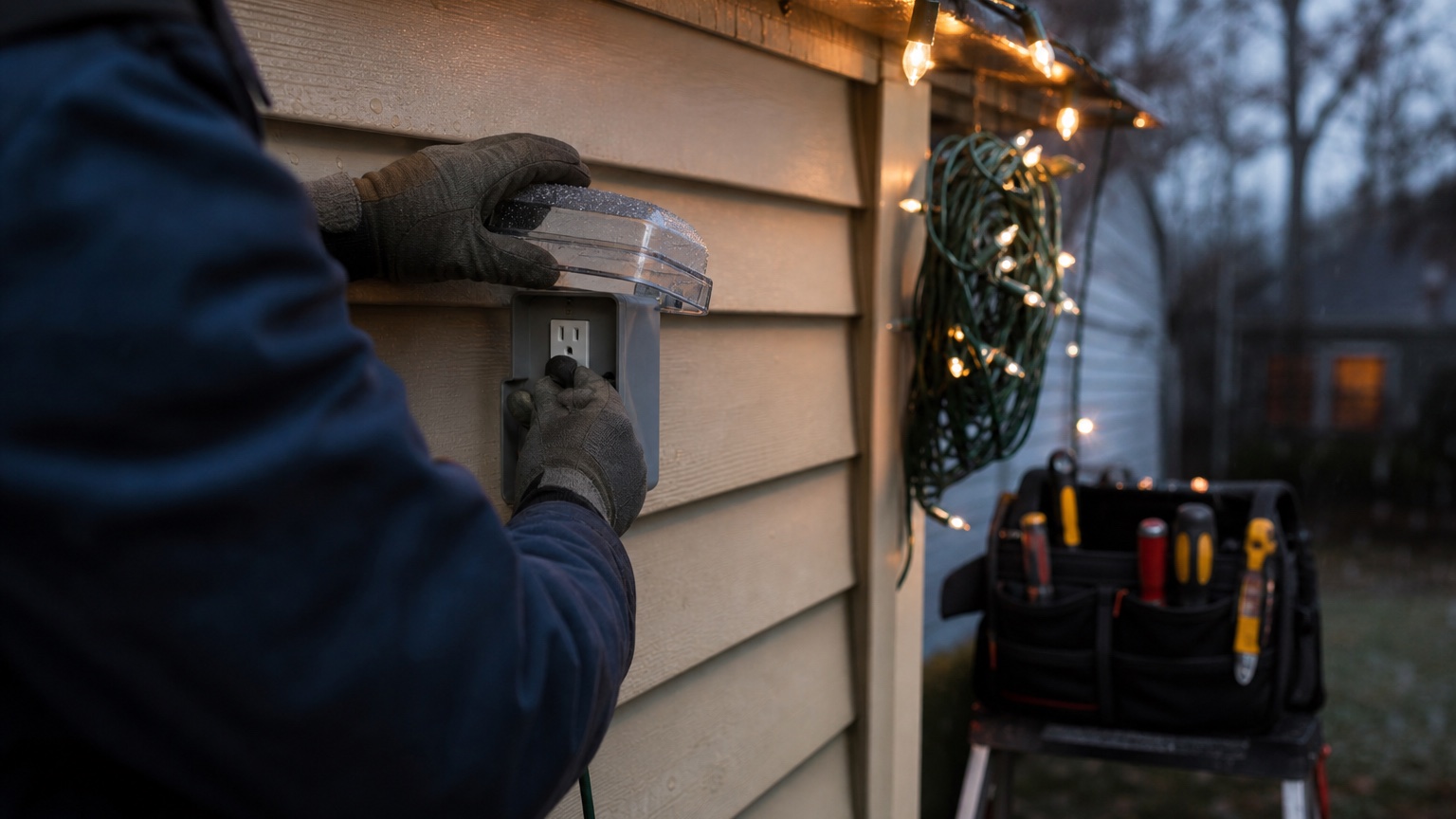
Most "my Christmas lights keep tripping the outlet" calls are a GFCI doing its job: water got into a plug, a cover, or a worn string, or the homeowner has piled too much onto one outdoor receptacle. The phone job is to sort the few calls that are real hazards from the many that need a reset and a little isolation work, then book the visits that turn into proper work: a weather-resistant GFCI, the right cover, or a new outdoor circuit.
Here is a phone script, a short list of red flags, an on-site checklist built on the code sections inspectors actually look at, and the fixes worth quoting.
Why these calls pile up in late November and December
The numbers are small per house but steady across the season.
- About 14,900 people were treated in emergency rooms for holiday decorating injuries in the Nov. 1, 2022 to Jan. 31, 2023 season, according to the U.S. Consumer Product Safety Commission. That works out to about 160 a day, and nearly half involved falls.
- Electrical distribution or lighting equipment was involved in 44 percent of home Christmas tree fires, in NFPA's 2016 to 2020 analysis. Electrical failure or malfunction was a factor in 34 percent.
- Three-quarters of those tree fires happened in December or January, and half happened between 3 p.m. and midnight.
That last point matters for your phones. The lights are on in the evening, which is when most problems get noticed, and that is when most shops' lines go to voicemail.
The IAEI, the electrical inspectors' association, names the two usual causes of outdoor GFCI trips plainly: sometimes the trip is warranted because a damaged cord or decoration is leaking current, and sometimes water is getting into the receptacle. Both are real problems. Neither is fixed by swapping in a non-GFCI device, and your CSR should never suggest that.
The 90-second phone script
The goal is to find hazards first, then gather enough detail that the tech arrives knowing what to bring.
Step 1: Safety questions (ask every time)
"Before anything else: do you see or smell any smoke, burning or melted plastic near the outlet, the cords or the panel?"
"Is the outlet, a plug or a cord hot to the touch, discolored or scorched?"
"Is there water standing in the outlet box or cover right now?"
"Has anyone gotten a shock or a tingle from the lights, a gutter, a railing or the outlet?"
If yes to smoke or flames: tell them to get out and call 911. Do not troubleshoot.
If yes to heat, scorching, standing water or a shock: tell them to leave the circuit off, do not touch or unplug anything wet, keep people and pets away, and book the first available emergency slot. Flag it red for dispatch.
Step 2: Sort the trip
"When you press reset on the outlet with nothing plugged in, does it hold?"
- Will not reset with nothing plugged in: likely a wiring, device or moisture problem in the box itself. Book a visit.
- Resets, then trips when the lights go on: the load side. Go to step 3.
- Only trips after rain, snow or a heavy dew: water in plugs, connections or the cover. Note it for the tech.
"Can you tell me if this outlet has a flip cover, or a bubble cover that closes over the plug while it's in use?"
"Are any cords run through a window or a door to get power outside?"
Step 3: Isolate, only if it is safe and dry
If none of the red flags apply and everything is dry, the CSR can walk the caller through the basics:
- Unplug every decoration from that outlet and any outlets downstream of it.
- Press reset.
- Plug in one string or decoration at a time and wait a minute between each.
- If one item trips it on its own, leave that item unplugged and tell us what it is.
Then book the visit anyway if the trip keeps happening, if the outlet is the only one outside, or if cords are running through doors or windows. Those are the jobs.
What to write on the ticket
- Which outlet, and whether it has a flip cover or an in-use cover
- Resets with nothing plugged in: yes or no
- Trips with load, after rain, or both
- Any item that trips it alone
- Cords through windows or doors: yes or no
- Indoor or outdoor light sets, and whether old incandescent strings are involved
- Any red flag from step 1
What the tech checks on site
This checklist follows the IAEI's breakdown of the NEC requirements for outdoor receptacles, plus CPSC guidance for the homeowner talk. Check which NEC edition your jurisdiction has adopted, and remember that the authority having jurisdiction makes the final call on whether a spot is damp or wet.
The receptacle and cover
- Damp or wet location. Under the NEC's Article 100 definitions, a damp location is protected from weather and not subject to saturation, such as under a soffit or an enclosed porch. A wet location includes unprotected spots exposed to weather. Rain, sleet and snow make most open wall receptacles wet locations.
- Cover type. NEC 406.9 lets a damp-location receptacle use a cover that is weatherproof when closed, the standard flip cover. A wet-location receptacle needs an enclosure that stays weatherproof whether or not a plug is inserted: the in-use or bubble cover. A flip cover propped open by a light cord in the rain is a classic trip source.
- WR marking. 15- and 20-amp, 125- and 250-volt nonlocking receptacles in damp or wet locations must be listed weather-resistant and marked WR. The IAEI notes that non-WR devices outdoors can rust apart and break down from UV exposure.
- GFCI protection. Outdoor 15- and 20-amp receptacles should have Class A GFCI protection. OSHA describes a GFCI as tripping when the current going out differs from the current returning by about 5 milliamps, in as little as 1/40 of a second. Every string and connection on the circuit can leak a little, especially when wet, and that leakage adds up on one GFCI.
The decorations and cords
- Cords through windows or doors. The IAEI calls this out directly: closing a door or window on a cord can damage it and lead to shock or fire.
- Cord size. Light-gauge extension cords, 16 AWG and smaller, may not carry decoration loads safely and can overheat.
- Outdoor rating. Lights and decorations used outside should be rated for damp or wet locations.
- String limits. CPSC advises never connecting more than three sets of incandescent lights together and never overloading outlets.
- Condition. Look for frayed cords, broken lamps, damaged insulation and missing ground prongs. Damaged items should not be used.
If your shop installs the lighting
NEC 590.3(B) limits temporary holiday lighting and decorations to 90 days from installation, according to the IAEI. If you offer an install-and-remove service, put the removal date on the work order when you book it.
Turning a reset call into the right job
A homeowner who calls about a tripping outlet usually has one of three underlying problems. Quote the fix for the problem, not just the reset.
1. The outlet and cover are wrong for the spot
Fix: replace with a WR-marked GFCI receptacle and an in-use cover suited to a wet location.
How to explain it: "Your cover only seals when nothing is plugged in. With a cord in it, rain gets in and the GFCI trips, which is what it's supposed to do. The right cover seals with the plug in."
2. One outdoor outlet is carrying the whole display
Fix: add a dedicated outdoor receptacle circuit, often at the eave or near where the display actually goes, so the load is split and nothing runs through a window.
How to explain it: "Right now everything outside runs through one protected outlet. Every string and every connection adds a little leakage, and when it's wet that adds up. A second circuit splits the load and puts power where you actually need it."
3. The decorations are the problem
Fix: no electrical work needed beyond confirming the circuit is healthy. Tell them which item tripped it, recommend outdoor-rated replacements, and point out CPSC's three-incandescent-set limit.
Why it still matters: an honest "your outlet is fine, this string is bad" visit costs you little and earns trust. That customer calls you for the panel upgrade, the EV charger or the generator inlet later.
Book the permanent fix now
Some homeowners will not want new circuits installed in mid-December. Offer to schedule the permanent fix for early next fall, before decorating season, and set a reminder on the ticket.
Staff the phones for the hours the lights are on
Half of the tree fires in NFPA's data happened between 3 p.m. and midnight. The lights are on in the evening, and that is when homeowners notice a dead outlet, a burning smell or a tingle from a gutter. If your line goes to voicemail at 5 p.m., the red-flag calls wait until morning, and the routine ones call whoever answers.
Three things help this time of year:
- Put the step 1 safety questions on whatever answers your phones after hours, whether that is an on-call tech, an answering service or a call-center script.
- Give the after-hours answerer a clear escalation rule. Smoke or flames means 911. Heat, scorching, standing water or a shock means wake the on-call tech.
- Book routine trip calls into the next open slot on the spot, with the ticket notes above, so the tech shows up with the right receptacle and cover on the truck.
If you would rather not pay for a call center, an AI receptionist such as Rivet can answer every call 24/7, tells callers it is an AI, books jobs onto your calendar and sends you the summary, so the 9 p.m. tripping-outlet call is a booked job, not a voicemail.
Bottom line: most holiday-light calls are GFCIs doing their job. Ask the safety questions first, isolate the trip by phone when it is dry and safe, and send the tech to fix the cover, the receptacle or the circuit that caused it.
Sources
Keep reading
Ice dam calls: a roofing shop's phone script, insurance talk and the fix to quote after the thaw
Sort every ice dam call into one of three jobs in the first minute, tell callers honestly what insurance usually covers, and turn this winter's emergency visits into air-sealing, ventilation and ice-barrier work.
Nov 19, 2026 · 8 min read
Brown Friday 2026: a drain shop's phone and dispatch plan for the day after Thanksgiving
The day after Thanksgiving brings about 50% more drain calls than a normal Friday. Here's the staffing math, a five-question triage script, a disposal-jam talk-through and the pre-holiday customer message to send this week.
Nov 16, 2026 · 8 min read
Winter outage calls: a triage and safety playbook for electrical contractors
When a storm takes the grid down, your phones fill with emergencies, broken generators and install leads at once. Here is how to sort them in 30 seconds, the CPSC-based safety script to read on every call, and what to set up before the first storm.
Nov 13, 2026 · 6 min read